Planning Notes for Coordinating Lighting Orders with Hotel FF&E
A hotel lighting order is ready when each fixture, control, finish, installation interface, and approval sample is tied to the same room schedule. Coordinating those details with furniture and finishes early makes supplier comparisons more meaningful and reduces late design decisions.
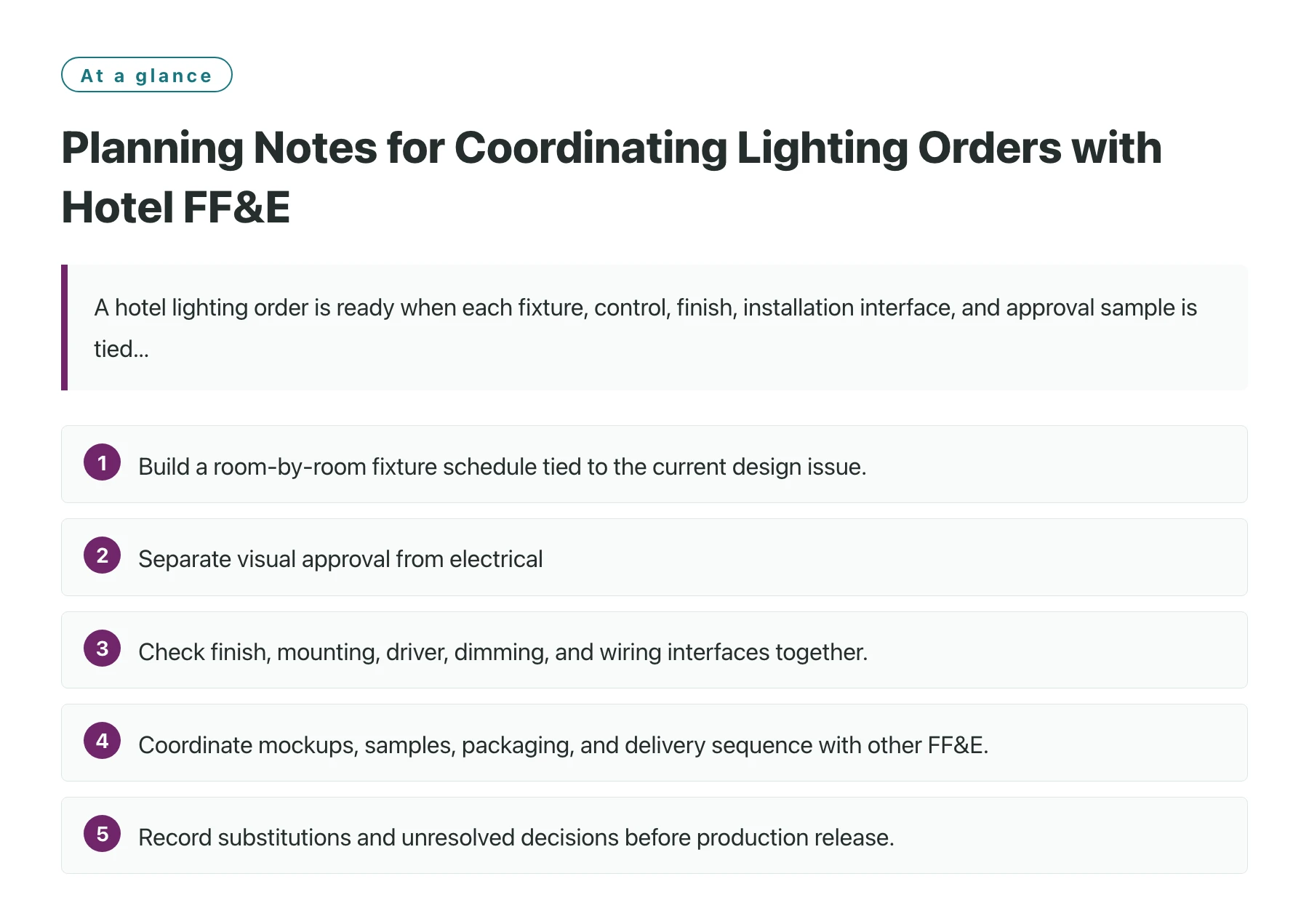
Key takeawaysBuild a room-by-room fixture schedule tied to the current design issue. · Separate visual approval from electrical, control, and compliance review. · Check finish, mounting, driver, dimming, and wiring interfaces together. · Coordinate mockups, samples, packaging, and delivery sequence with other FF&E. · Record substitutions and unresolved decisions before production release.
Hotel lighting sits between architecture, interior design, electrical engineering, operations, and procurement. A fixture can meet its catalogue description yet still fail the room because the finish, beam, driver, mounting detail, control protocol, or delivery sequence was never aligned.
1. Start with the room schedule and design issue
Create one register for guest rooms, corridors, public areas, back-of-house spaces, and exterior zones. For each location, capture the fixture tag, quantity, reflected ceiling plan reference, mounting method, finish, lamp or LED specification, control group, emergency requirement if applicable, and approval status. Record the drawing revision and date so a quotation can be traced to the design it priced.
Keep design intent and purchase data linked but distinct. The designer may describe a visual effect, while the electrical consultant defines load, driver, dimming, and circuit needs. Assign an owner to resolve conflicts instead of asking each supplier to interpret incomplete drawings independently. Add an open-issues column for dimensions, ceiling conditions, access panels, and coordination with sprinklers or HVAC.
2. Define what “matching” means across the property
Hotels often repeat a visual language across room types while using different fixture sizes, optics, or mounting details. State which characteristics must remain consistent: visible trim, metal finish, glass diffusion, color appearance, dimming behavior, or control interface. Then list approved variations by room type. This prevents a visually similar substitute from quietly changing glare, light distribution, service access, or the guest experience.
If color-tunable or dim-to-warm products are under consideration, describe the actual operating scenes and how users should control them. DOE notes that tunable systems can involve different control arrangements and tradeoffs; for example, changing intensity and color together may not suit every use. Confirm the behavior in a representative mockup and document any control limitations before extending the selection across multiple room types. [1] lighting suppliers for hospitality projects can be used when the project team needs supplier coordination across hotel furniture and lighting categories.
3. Compare supplier quotations on the same basis
Issue the same schedule, drawings, quantities, finish references, delivery destination, and requested documentation to every bidder. Ask each to identify the factory and production location, quote validity, minimum order, sample or tooling charges, lead-time assumptions, packaging, spare units, warranty terms, and any excluded work. Separate a firm price from optional alternatives so a lower total does not conceal a different scope.
Request a line-by-line deviation schedule. For each exception, show the specified item, offered item, reason, cost or schedule effect, and the party responsible for approval. Compare cost at the level of the installed package: a fixture price alone may exclude drivers, control devices, mounting accessories, replacement parts, or commissioning support. Keep freight and duty estimates distinct from confirmed charges.
4. Review samples and mockups at the right scale
A finish chip can screen color and texture, but it cannot demonstrate beam spread, glare, dimming, shadows, or how light falls on a headboard, mirror, artwork, or stone surface. Review a complete representative fixture where possible. Include the proposed driver and control combination, not a generic display sample that differs from the quoted configuration.
Set mockup acceptance criteria before review: viewing conditions, scene settings, adjacent materials, camera limits if photos are used, and who signs off. Record the approved manufacturer, model, finish, components, and sample date. If the design changes afterward, identify which approvals need repeating. Keep the approved sample or a controlled photo and specification set available to procurement, quality, and site teams.
5. Coordinate controls, installation, and maintenance
List the required scenes and operating modes by space: guest control, housekeeping, reception, conference use, night setting, or scheduled operation. Ask for a controls diagram, compatibility statement, wiring requirements, programming responsibility, and handover documents. The Department of Energy describes a planning process that considers objectives, system capabilities, communication options, and documentation; use those categories to make supplier proposals comparable. [2]
Check the physical interface as carefully as the electrical one. Confirm ceiling cutout, canopy size, driver location, access for replacement, cable entry, mounting hardware, and clearance from other services. Identify which trade supplies each component and who verifies the interface on site. A short coordination review before production can reveal a driver that will not fit above the ceiling or a fixture that conflicts with a joinery detail.
6. Plan samples, packaging, and phased delivery
Tie production lots to the project programme: mockup, first rooms, public areas, and later floors may require separate releases. Agree how model, finish, room type, and batch will be marked on cartons and packing lists. Ask for protective packaging that suits the product’s glass, polished metal, or delicate optical surfaces, and define how damaged cartons or shortages are reported.
For a multi-supplier FF&E package, align delivery windows with storage capacity and installation sequence. Do not ship a visually approved sample as if it were an approved production record unless its configuration is fully documented. Reserve time for incoming checks and replacement decisions. State which party holds spare units, how replacement parts are identified, and whether a finish batch difference requires review.
7. Use a release gate before placing the order
Before a purchase order is released, confirm that the current fixture schedule, approved samples, deviation log, control requirements, commercial comparison, and delivery plan share the same revision. List outstanding decisions with owner and due date. If a detail is intentionally unresolved, make the purchasing condition explicit rather than leaving it buried in an email thread.
After award, issue one controlled order schedule to the supplier and project team. Require written approval for substitutions, finish changes, component changes, and revised delivery dates. At inspection, sample against the approved record: verify tags, appearance, accessories, packaging, and the required documents. Close discrepancies with a disposition and evidence trail before goods are released for installation.
Sources
Frequently asked questions
When should hotel lighting be coordinated with furniture and equipment?
Begin during design development, when room layouts, ceiling plans, finishes, and furniture dimensions can still be reviewed together. Recheck the interfaces before sample approval and production release.
Is a finish sample enough to approve a hotel light fixture?
No. A finish sample helps judge appearance, but the team should also review the complete fixture, optics, driver, control behavior, mounting details, and representative room conditions.
What should be included in a hotel lighting quotation comparison?
Compare the same fixture schedule and identify model, components, finish, quantity, lead time, packaging, controls, accessories, exclusions, warranty, and deviations. Separate optional alternatives and uncertain logistics costs.
How can a project reduce late lighting substitutions?
Use a controlled schedule, approve a complete representative sample, document control and installation interfaces, and require written review of every proposed change before production.