Documents and Compliance in OEM/ODM Fragrance Production: Who Holds What
Compliance in fragrance production is not one document but a set of them, produced by different parties at different moments, and the most common mistake is assuming the factory holds all of them on the brand's behalf. It does not. A manufacturer can supply the technical file for the product it makes; the obligations attached to putting that product on a market stay with the brand. Sorting out which document belongs to whom before the first order is much cheaper than discovering the gap at customs.
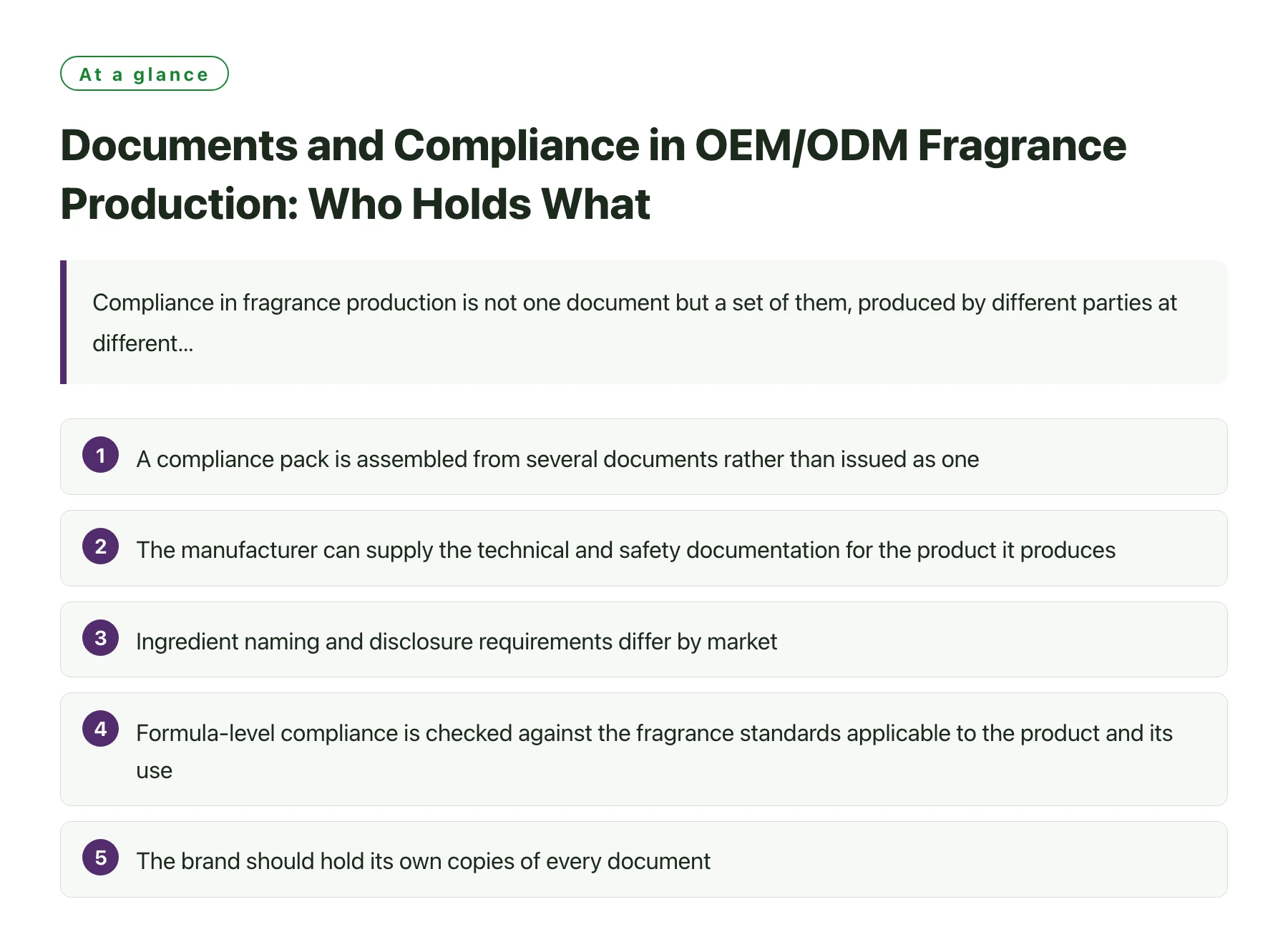
Key takeawaysA compliance pack is assembled from several documents rather than issued as one, and different parties produce different parts of it. · The manufacturer can supply the technical and safety documentation for the product it produces; the market-facing obligations belong to the party placing the product on the market. · Ingredient naming and disclosure requirements differ by market, so a document that satisfies one destination may not satisfy another [2]. · Formula-level compliance is checked against the fragrance standards applicable to the product and its use, not against the brand's intentions. · The brand should hold its own copies of every document, including the formula reference and the safety assessment, regardless of who paid for them.
Ask a room of first-time founders who holds the safety assessment for their product and most will say the factory. That answer is half right. The factory usually commissions or prepares it, because the assessment depends on the formula and on how the product is used; but the brand needs a copy, because the brand is the party that answers for the product in the market where it is sold.
The same half-right assumption recurs across the whole document set. Sorting the pack by who produces each item, and by who must retain it, turns a vague worry into a checklist that can be handed to a supplier and compared against their answer.
Compliance is a division of labour, not a deliverable
The phrase compliance pack suggests a folder a supplier hands over at the end of a project. In practice the pack is assembled from documents that appear at different stages: material documentation during development, safety assessment once the formula is frozen, labelling artwork once the market is known, and shipping documentation once the goods are ready.
Because the documents arrive at different times, the responsibility for them is easy to lose. A useful discipline is to name an owner for each one at the brief stage, alongside the commercial terms, so that nothing is waiting on an assumption.
The document that matters most is the one nobody asks for
That is usually the retained formula reference and its revision history. If the formula is adjusted after sampling — and it often is — the version that was assessed and approved has to be identifiable months later. Without a controlled reference, a later batch cannot be demonstrated to match what was reviewed.
The working document list
| Document | Produced by | What it is for | Who retains a copy |
|---|---|---|---|
| Formula reference and version history | Manufacturer or brand's perfumer | Proves which version was assessed and produced | Both parties |
| Material safety and use information | Fragrance house or manufacturer | Confirms materials are used within applicable limits | Manufacturer, brand on request |
| Safety assessment for the finished product | Qualified assessor engaged by either party | Supports the product's compliance in its market | Brand must hold |
| Ingredient disclosure and labelling data | Manufacturer, with brand input | Feeds the label and any market notification | Brand must hold |
| Batch record and certificate of analysis | Manufacturer | Shows what happened on a specific run | Both parties |
| Commercial and shipping documents | Manufacturer and freight provider | Moves the goods and supports the import | Brand must hold |
Highlight the two rows marked as brand-side. They are the ones most often left with the supplier, and they are the two an importer or a market authority is most likely to ask the brand to produce.
How the requirement changes by market
A document set is destination-specific. The same product sold into two markets can need different labelling, different notification and different evidence, which is why the destination belongs in the brief rather than in the shipping instructions.
The European Union
In the EU the finished cosmetic product has to satisfy that market's cosmetics rules, and the obligations sit with the party that places it on the market — normally the brand rather than the factory [1]. Ingredient naming follows the market's own inventory of cosmetic ingredients, which is the reference a formulator or a supplier will use when preparing label data [2]. The practical consequence is that a brand selling into Europe needs the product information available to it, not merely held by a supplier.
Canada and other markets with their own regimes
Other markets run their own cosmetic safety requirements and their own expectations about what a seller must be able to demonstrate, and the details do not map one-to-one onto the European set [3]. Treat each destination as its own small project: identify the labelling rule, the notification rule and the evidence rule, then confirm which of them the manufacturer routinely supports.
Markets with additional requirements
Some destinations add requirements beyond cosmetics regulation. Where a product is sold into markets that expect halal assurance, the documentation is normally handled as a separate track, and manufacturers that serve those markets state whether they work to halal requirements. The useful question is not whether a manufacturer mentions halal, but which documents it provides and who issues them.
The fragrance-specific layer
Sitting underneath the market requirements is the fragrance layer: the use limits that apply to individual materials according to how the product is used. Documentation of that check is normally the fragrance house's or the manufacturer's responsibility, and it is worth asking for confirmation that the assessment was made against the applicable standards for your product category [4]. A brand does not need to perform this analysis, but it does need to know it happened.
Ask for the compliance list in writing before the first order, then read it as a responsibility map rather than a menu. For each line, ask three questions: who produces it, when is it available, and where does the brand's copy live. Any line with no answer is a project risk, and the cheapest time to close it is while the formula is still open.
Building the pack without building a bureaucracy
The full list can look heavy for a small brand, and it does not have to be built at once. What matters is sequencing: the material and formula documentation is needed first, the safety assessment follows the frozen formula, and the market-facing documents are prepared once the destination and the label are fixed.
A manufacturer with an established export routine usually has most of this by habit. Checking a published its background and certifications against a list of your own is a quick way to see which items a supplier treats as standard and which it treats as a special request. The same applies to the technical side of production: understanding what safety testing in perfume manufacturing covers makes it obvious which documents come out of testing and which come out of the quality system.
The final habit worth adopting is custody. Keep a single folder, in the brand's own control, with every document the project produces, including the versions that were superseded. Markets change, labels get revised, and a brand that can produce its own history does not have to ask a former supplier for it. If the relationship with a Guangzhou Xuelei or any other manufacturer ends, that folder is the difference between moving a product and rebuilding it.
What to confirm before signing
Confirm the document list, who produces each item, the cost of any testing or assessment that is billed separately, and the schedule for each document relative to the production date. Written answers to those four points turn compliance from a post-production scramble into part of the project plan.
Sources
- European Commission: Cosmetics in the EU —— The European Commission's overview of EU cosmetics rules, including the responsible person, product information file and safety report requirements.
- EU CosIng — Cosmetic Ingredient Database (European Commission) —— The European Commission's CosIng database of cosmetic ingredients, listing ingredient functions, restrictions and labelling requirements under EU cosmetics law.
- Health Canada: Cosmetic Safety —— Health Canada's cosmetics pages, covering cosmetic notification, the ingredient hotlist and safety requirements for cosmetics sold in Canada.
- IFRA Standards Library (International Fragrance Association) —— The IFRA Standards Library lists the restrictions the fragrance industry applies to individual fragrance ingredients, based on safety assessments; it is the reference point for compliant fragrance formulation.
Frequently asked questions
Who is responsible for the safety assessment of a perfume?
The assessment is normally prepared by a qualified assessor engaged by the manufacturer or the brand, because it depends on the formula and the way the product is used. The brand needs its own copy, and in markets where the brand is the party placing the product on the market, the market-facing obligations sit with the brand.
Will the factory provide labelling compliant with my market?
A manufacturer with export experience will normally prepare label data and artwork input, and it will know the labelling conventions of the markets it serves. Final responsibility for the label in a given market still rests with the party selling there, so the brand should review it rather than accept it unread.
Do I need a different document set for every market?
Yes, in part. Ingredient disclosure, notification and labelling rules differ by destination, and requirements do not transfer one-to-one. The technical and batch documentation is largely the same everywhere; the market-facing layer is not.
What is the difference between a certificate and a batch record?
A certificate reports the result of a test or confirms an audit against a standard. A batch record documents what actually happened during a specific production run. Both are useful, and the batch record is the one that answers questions about your order.
How long should I keep compliance documents?
Keep them for as long as the product is on sale and for a reasonable period afterwards, and keep superseded versions too. If a formula or a label is revised, the earlier version is what explains the products already in the market.