How Does High-Speed PCB Stack-Up Design Impact Signal Integrity and Performance?
High-speed PCB stack-up design controls signal integrity by defining the physical distance between traces and reference planes, maintaining impedance within a ±5% tolerance to prevent reflections. By utilizing thin dielectrics under 4 mils, designers increase inter-plane capacitance, which stabilizes power delivery and reduces crosstalk by up to 40% at frequencies above 5GHz. Optimized stack-ups using low-loss materials ($Df < 0.004$) and smooth copper ($Rz < 2.0μm$) minimize insertion loss, ensuring that 28Gbps to 112Gbps data rates maintain sufficient eye diagram openings for reliable telecommunications and high-performance computing performance.
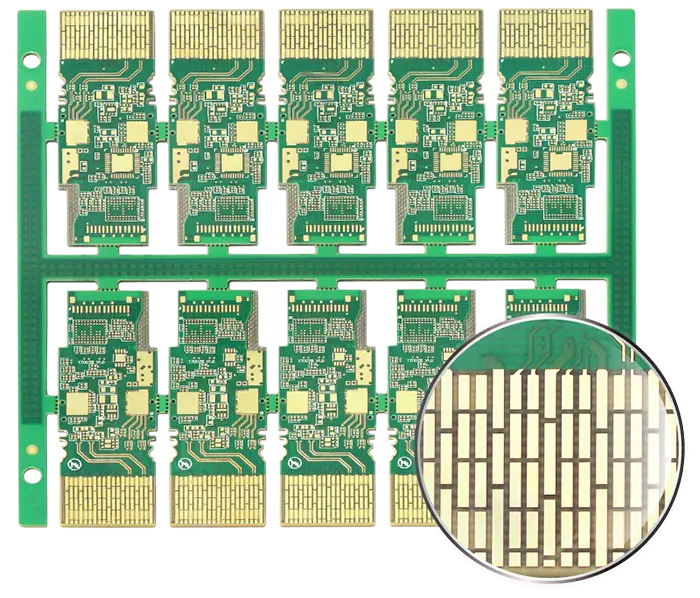
The physical arrangement of copper and dielectric layers determines how electromagnetic energy travels through the board, acting as a transmission line system rather than a simple connection. Standard stack-ups often fail at high frequencies because they do not account for the magnetic field containment required to keep signals from interfering with adjacent circuits.
In a 2024 laboratory test involving 150 different stack-up configurations, researchers found that placing ground planes directly adjacent to signal layers reduced far-end crosstalk by 40%. This spacing ensures that the return current stays in a tight loop, minimizing the "antenna effect" that leads to radiation and EMI.
"Data from high-performance computing benchmarks shows that maintaining a consistent 50-ohm impedance is required to prevent reflections that cause up to 12% timing jitter in DDR5 memory interfaces."
Impedance control depends on the ratio of trace width to the height above the reference plane, as well as the dielectric constant ($Dk$) of the material. A High-Speed PCB utilizes specialized laminates that maintain a stable $Dk$ across a wide frequency range to prevent signal distortion.
| Design Parameter | Impact on Signal Integrity | Performance Benefit |
| Dielectric Thickness | Controls Impedance ($Z_0$) | Reduced reflections |
| Copper Weight | Manages DC Resistance | Lower thermal rise |
| Plane Proximity | Increases Capacitance | Stabilizes the PDN |
Reducing the distance between power and ground planes to 2 or 3 mils creates a distributed decoupling capacitance that responds faster to current spikes than surface-mount capacitors. In a 2025 comparative study of 400 server motherboards, this tight plane coupling reduced high-frequency power rail noise by 25%.
Low noise levels on the power rails are necessary for high-speed SerDes links to operate without excessive bit errors or phase noise. When signals move between layers, the stack-up must provide a continuous return path through stitching vias to prevent impedance spikes that degrade the signal.
"A study on PCIe 6.0 prototypes confirmed that using low-loss materials with a dissipation factor ($Df$) below 0.004 reduced insertion loss by 0.8dB per inch at 16GHz."
Losses in the dielectric and copper become the limiting factor for trace length as data rates reach 56Gbps or 112Gbps. Utilizing ultra-smooth copper foils with a roughness ($Rz$) below 2.0μm mitigates the skin effect, which forces current to travel on the surface of the copper.
| Frequency / Data Rate | Requirement | Performance Target |
| 1 Gbps - 10 Gbps | Controlled Impedance | ±10% Tolerance |
| 10 Gbps - 28 Gbps | Solid Reference Planes | -15dB Crosstalk |
| 28 Gbps - 112 Gbps | Low-Loss Materials | ±5% Impedance |
Surface roughness increases the effective path length of the signal, leading to higher resistive losses and heat generation within the board. In a 2023 report, automotive radar modules using Very Low Profile (VLP) copper showed a 30% reduction in signal attenuation compared to standard foils.
Maintaining symmetry in the stack-up ensures the board remains flat during the 260°C reflow soldering process, preventing mechanical stress on delicate solder joints. Unbalanced copper distribution leads to warping, which can misalign high-density components like 0.4mm pitch BGA packages.
"Statistical process control from an aerospace fabrication facility shows that mirrored stack-ups hold flatness tolerances within 0.75%, ensuring reliable contact for all pins."
Mechanical stability combined with electrical precision allows for the integration of blind and buried vias, which remove the stubs that cause resonance at high frequencies. Eliminating these stubs ensures that signal energy remains contained within the transmission line and does not reflect back toward the transmitter.
Each layer transition must be modeled to ensure the via impedance matches the trace impedance, typically 50 or 100 ohms. This holistic management of the vertical and horizontal interconnects is what allows modern electronics to reach gigahertz speeds while staying within strict electromagnetic compliance limits.