Temporary Flooring and Staging Panels for Concrete Works
A site needs two different panels and usually orders one. The form face touches wet concrete; the temporary flooring and staging boards carry people. Anti-Slip Film Faced Plywood — sold as Wire Mesh Film Faced Plywood on the manufacturer's page — is built for the second job, with a textured hexagonal surface, published thickness from 9 mm to 21 mm and a standard 1220 × 2440 mm sheet.

Key takeaways
- The surface is a textured hexagonal film, available single-sided with a smooth reverse or double-sided for walkboards.
- Sheets come in 1220 × 2440 mm as standard, plus 1250 × 2500 mm, 1500 × 3000 mm and a custom window topping out at 1830 × 3830 mm.
- Thickness covers 9 mm to 21 mm, matched to the load a route or platform will see.
- Adhesive options are WBP (Phenolic), melamine and E1/E0, so the bond can be matched to site conditions.
Two jobs, two panels: form face and access route
Formwork design tends to focus on the face that meets concrete, because that is the surface the client inspects. The panels underfoot are treated as an afterthought and assembled from whatever is left on the stack, which is how crews end up walking on smooth film in wet weather. Grip is a safety specification, and it belongs in the same drawing as the pour layout.
Separating the two roles also protects the budget. A scored, walked-on panel still has years of formwork left in it as a back-up face, while a smooth form panel that has been used as a walkway usually has nothing left at all. Label the access stock as such when it arrives and the confusion stops.
How a textured face provides grip
The surface is a wire-mesh pattern pressed into the film, described as hexagonal, and it is what separates this product from standard film faced stock. Boots and tools grip the raised pattern even when the panel is wet, which is the condition that matters on a scaffold board in January. The base is a phenolic film system, so the same panel resists moisture and the alkaline splash that comes with concrete work.
Order it single-sided where the reverse will sit against framing, or double-sided where both faces may be walked on, such as a suspended platform or a ramp that is turned over between uses. Edges arrive sealed, which is the detail that decides whether the panel is still flat after a fortnight of site weather.
Choosing a size and thickness for the route
| Option | Published values | Typical duty |
|---|---|---|
| Standard sheet | 1220 × 2440 mm | Walkboards, ramps, general access |
| Mid formats | 1250 × 2500 mm and 1500 × 3000 mm | Staging platforms and large deck panels |
| Custom | Up to 1830 × 3830 mm | Single-piece platform decks that avoid joints |
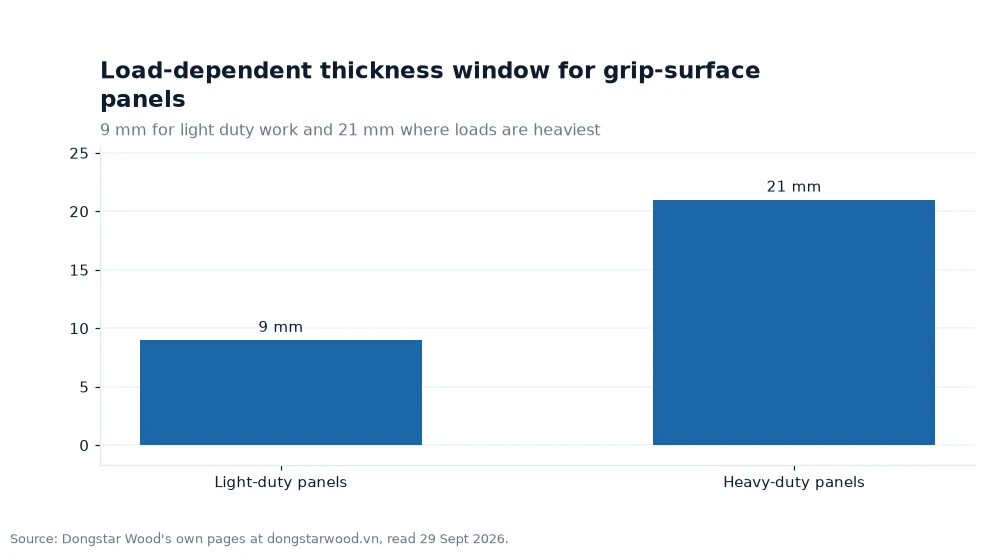
| Thickness | 9 mm to 21 mm | Light routes at the low end, loaded staging at the high end |
| Bond | WBP (Phenolic), melamine, E1/E0 | Wet sites, humid storage, emission-sensitive interiors |
The thickness band is the one to argue about. A 9 mm board spanning a metre between supports will flex under a loaded barrow; the same route built with 18 mm panels will not, and it can be stripped and reused on the next phase.
Worked example: covering a staging platform
Take a platform 2.4 m wide and 6.0 m long, which is 2.4 m × 6.0 m = 14.4 m². A standard 1220 × 2440 mm sheet works out at 2.98 m² (1.22 m by 2.44 m), so the pure area calculation is 14.4 ÷ 2.98 = 4.83, or five sheets with the cut waste absorbed.
Run the same platform in the wider format. A 1500 × 3000 mm panel is 1.5 m × 3.0 m = 4.5 m², which gives 14.4 ÷ 4.5 = 3.2, so four sheets — example figures based on published panel sizes, and the layout still has to respect bearer positions on the drawing.
Bond choice on a wet site
Site conditions drive the adhesive decision more than the load does. WBP (Phenolic) is the usual choice where panels will be stored outdoors between phases or used on a deck that sees rain, and it is the bond most likely to survive being stripped wet. Melamine is the cost-conscious option for covered works, while E1/E0 grades matter where panels are used inside a building shell during fit-out.
Whichever bond is specified, the storage rule stays the same: keep stacked panels off the ground on bearers, and let air move between sheets. A sealed edge cannot compensate for a stack that has been sitting in a puddle for a week.
Reuse, edge care and inspection between phases
The product is described as supporting multiple reuse cycles with proper edge and surface maintenance, which is a fair description of how temporary works actually behave. The failure mode is rarely the film; it is a chipped corner that lets water into the core, or a board that has been used as a saw horse and no longer sits flat.
A short inspection before each phase is enough to sort the stack. Panels that are flat with intact edges go back on the access route, panels with local film damage move to non-critical walkways, and anything with a soft delaminated corner becomes a cutting template or goes out of service.
Where these panels are used on site
The application list is broader than a walkway. It names concrete work at both ends of the scale, from heavy-duty formwork and industrial slab work to high-rise shuttering, then adds the places people stand: scaffolding boards with a slip-resistant face, roofing walkboards, temporary flooring, safe access platforms and bridge deck work. Those duties are not interchangeable, which is what the thickness band is there to absorb. Anyone comparing quotations for an Anti-slip Film Faced plywood should check the thickness band and the bond class on both offers, because those two lines change the duty the panel can carry.
Where the deck is the structure being built, engineers specify the form panel; where the deck is a route to the pour, they specify grip. Ordering both from one mill keeps the sizes compatible, so offcuts from a form panel fit as infill on an access route.
Frequently asked questions
Is a textured anti-slip panel suitable as a form face?
It can be, and the manufacturer lists heavy-duty formwork and industrial slab formwork among its applications. The trade-off is surface finish: the hexagonal texture transfers a pattern to the concrete, so use it where that finish is acceptable or where the visible face is formed by a smooth panel.
What thickness is right for a temporary site route?
The published band runs from 9 mm to 21 mm, with the choice set by support spacing and the weight crossing it. Light pedestrian routes tolerate thin panels over close bearers, while a route carrying loaded barrows or plant needs the higher end of the range and tighter support centres.
Which adhesive should be specified for outdoor storage?
WBP (Phenolic) is the sensible specification where panels are stored outside or stripped in wet weather, with melamine as the economical option for covered works and E1/E0 grades for interior use. Seal cut edges on site, because an open edge lets water into the core regardless of the bond.
Where to check the options
Start with the panel schedule and match each route to a format: sizes, thicknesses, film types and adhesives are listed on the anti-slip panel page. Where the concrete is formed by the same board rather than walked on, compare the smooth-face options in the film faced panel range, which covers films, cores and the full size window. For short phases where the boards will be written off after a few uses, the economical black film option is usually the cheaper route than putting premium stock under muddy boots.
Sizes, thicknesses, film types and adhesive classes quoted above are published on that that company's own pages, viewed on 29 Sept 2026 and taken for these notes and taken for these notes and carried into this guide[1].